Deciding where to store your boat over the off-season is one of those decisions that seems simple until you start weighing all the factors. In Colorado Springs, the choice carries a few extra wrinkles that boaters in other parts of the country don’t have to think about. Altitude, hail season, dramatic temperature swings, and intense UV exposure all play a role in how well your boat holds up between trips to Pueblo Reservoir, Eleven Mile, or Rampart.
Outdoor Boat Storage
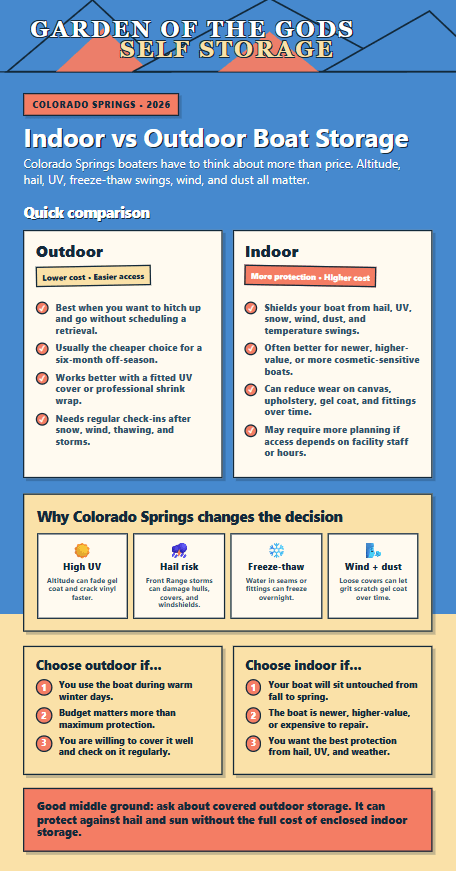
Outdoor storage means your boat sits in an open or partially covered lot, either on your own property, at a marina, or at a self-storage facility. The boat is typically kept on its trailer and either covered with a fitted tarp or professionally shrink-wrapped before the cold season begins.
The main advantage is accessibility. When you’re ready to head out, you pull up, hitch the trailer, and go. There’s no waiting for staff assistance or scheduling a retrieval. For boaters who like to take advantage of warm mid-winter days (and Colorado Springs gets plenty of those, even in January), that flexibility matters.
Outdoor storage is also the more affordable option. At a self-storage facility, outdoor boat storage costs considerably less per month than a climate-controlled or enclosed unit, which can make a real difference over a six-month off-season.
What Outdoor Storage Looks Like in Colorado Springs
Colorado Springs diverges from most of the country in ways that make outdoor storage more demanding than it would be at sea level in a mild climate.
UV exposure at 6,000 feet is significantly more intense than at lower elevations. Even on cool, overcast days in winter, UV radiation at altitude can fade gel coat, crack vinyl upholstery, and degrade canvas covers faster than owners expect. A quality, UV-resistant cover or professional shrink wrap is essential, and it’s worth investing in a cover rated for high-altitude conditions rather than entry-level options.
Hail is probably the most underappreciated risk for outdoor boat storage on the Front Range. Colorado Springs sits in one of the most hail-prone corridors in the United States, with peak season running from May through August. A single severe hailstorm can cause significant damage to fiberglass hulls, canvas tops, and windshields. Boats stored outdoors without overhead protection during hail season are genuinely at risk, and homeowner or boat insurance policies vary considerably in what they cover for weather-related damage to stored boats. It’s worth reviewing your policy before settling on outdoor storage.
Temperature swings are another factor. Colorado Springs regularly sees 40-degree temperature changes within a single day, especially in spring and fall. Any water that finds its way into cracks, seams, or fittings during a warm afternoon can freeze overnight. Repeated freeze-thaw cycles are hard on hulls, plumbing fittings, and any compartment that traps moisture. Proper winterization, including draining all water systems completely, is non-negotiable for outdoor storage in this climate.
Wind and dust from the plains can also take a toll. Fine grit carried by Front Range winds will work its way under a loose cover and scratch gel coat over time. Making sure any cover fits snugly and checking it after major wind events is part of the maintenance routine for outdoor storage here.
For boaters who store outdoors, regular check-ins are important: clearing snow accumulation before it gets too heavy, watching for cover damage after windstorms, and inspecting for any signs of water intrusion after a thaw.
Indoor Boat Storage
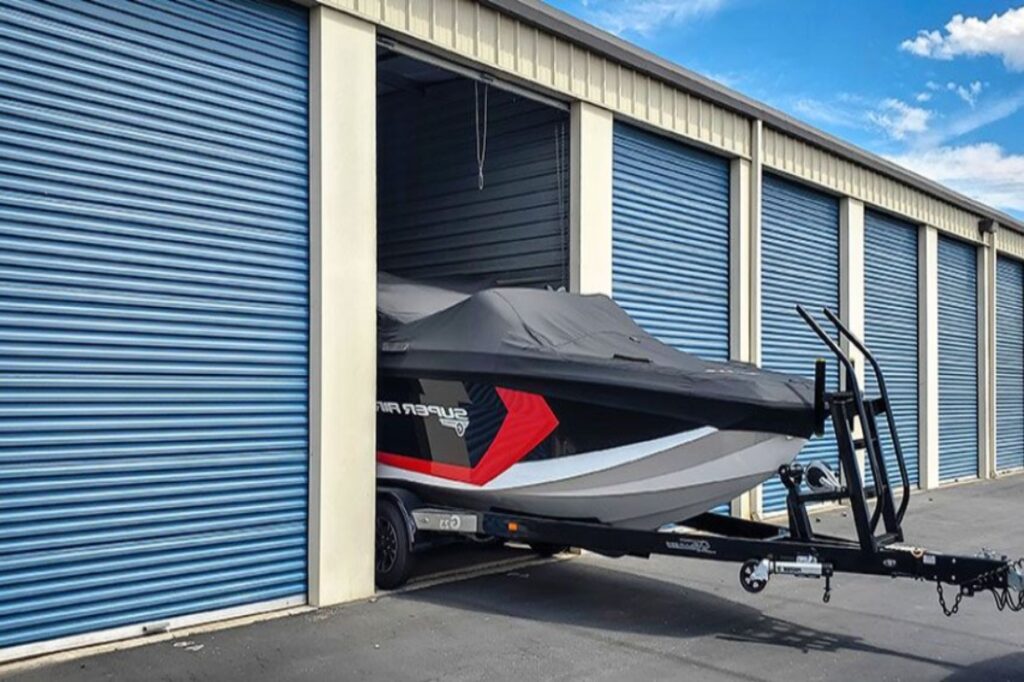
Indoor storage means your boat is kept inside an enclosed structure. This might be a dedicated boat storage building, an enclosed unit at a self-storage facility, or your own garage or outbuilding if you have one with enough clearance.
The primary benefit is protection from the elements. Inside a building, your boat is shielded from hail, UV rays, snow accumulation, temperature extremes, and wind-driven dust. The wear and tear that adds up over an outdoor winter is largely avoided. Boats that spend their off-seasons indoors consistently show less cosmetic degradation and tend to have longer service lives on components like canvas, upholstery, and gel coat.
Security is also meaningfully better in most indoor facilities. Enclosed storage limits access to authorized individuals only, which reduces both the risk of theft and the risk of vandalism. A quality facility will have gated entry, security cameras, and individually secured units.
One practical consideration for indoor storage is accessibility. At many facilities, retrieving your boat requires some advance planning or coordination with staff. If you’re the type of boater who likes to act on a spontaneous weekend decision, that’s worth factoring in when choosing a facility. Some enclosed facilities offer more convenient access than others, so it’s a good question to ask when shopping for a space.
Why Indoor Storage Makes Particular Sense in Colorado Springs
In Colorado Springs, indoor storage has a stronger case than it might in a more forgiving climate. The combination of intense UV, serious hail risk, and repeated freeze-thaw cycles makes the elements here harder on boats than in many other regions.
For newer boats or those with significant cosmetic or mechanical investment, indoor storage often pays for itself in reduced maintenance and repair costs. Canvas replacement, gel coat restoration, and UV-damaged upholstery are all expenses that tend to show up sooner for boats stored outdoors on the Front Range. The cumulative cost of outdoor storage, when you factor in wear, repairs, and more frequent detailing, can close the gap with indoor pricing over time.
If you’re storing through the full winter and the boat won’t be used until spring, indoor storage is the more protective choice in this climate. If you prefer to stay flexible and take the boat out on warm winter days, outdoor storage with a quality cover and a thorough winterization job is a workable approach, as long as you’re prepared to keep an eye on it.
Making the Decision
The right choice depends on a few practical questions.
How often do you use your boat in the off-season? Boaters who want flexibility to get out on warm winter days lean toward outdoor storage. Those who store from October to May without touching the boat lean toward indoor.
What is the value and age of your boat? Newer or higher-value boats benefit more from the protection of indoor storage, particularly in a climate with real hail risk.
What is your budget? Outdoor storage costs less. A quality shrink wrap job and regular check-ins can stretch your outdoor storage dollars considerably, but factor in the potential cost of weather-related repairs over time.
Is covered outdoor storage an option? Some outdoor storage areas offer covered spaces that provide meaningful protection from hail and UV without the full cost of enclosed indoor storage. These can be a good middle ground worth asking about at local facilities.
Whatever you decide, the most important step is making a conscious plan before the off-season hits. A well-prepared boat in outdoor storage will fare better than a neglected one indoors. Colorado Springs is a great place to be a boater, and a little planning goes a long way toward keeping your boat in great shape for every outing ahead.